“Is 18K gold earrings okay with metal allergies?”
“Is 10 gold prone to metal allergies?”
“Metal allergies are so severe that even 18-karat gold has metal allergies. Is your tantalum okay?”
“There are 18K, gold plates, gold filled, etc., which one is safe for metal allergies?”
As you can see, we often receive questions about metal allergies about 18K gold, 14K gold and 10K gold.
Generally, gold and platinum are sold because they are less likely to have metal allergies, but what about the reality?
I would like to write in detail.
What is 18K Gold?
I think you often hear the word 18 gold. Or it is written as 18K.
The purity notation of gold is often expressed in 24 divisions, and 18/24, that is, gold with a purity of 75% is called 18 gold. The 18K K is the carat karat K. By the way, pure gold is called 24 gold.
In most cases, 18K gold is often yellow gold, which is an alloy of 75% gold, 12.5% silver and 12.5% copper.
This 18K yellow gold is the so-called general 18K gold.
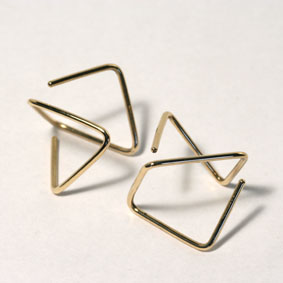
Besides, 18K pink gold, which is an alloy of 75% gold and 25% copper,
There are various 18-karat gold in different colors, such as 18-karat gold white gold, which is an alloy of 75% gold and 25% palladium.
Other rare ones are 18K green gold, which is an alloy of 75% gold and 25% silver.
In addition, 14 gold is 14/24 = about 58% pure gold, and 10 gold is 10/24 = about 42% pure gold. The higher the number, the higher the gold content.
18K yellow gold is a great jewelry material
When you hear about 75% pure gold, you might think, “Why is it a mixture of 25% and contains only 75% gold?”
Moreover, although the ratio of gold is 75% by weight, silver and copper have a light specific weight, so the volume ratio contains only 59.3% of gold.
However, there is a reason why most gold is treated in the form of 18K yellow gold in the jewelery world.
When viewed as a jewelry material, 18K yellow gold is far superior to 100% pure gold (24K).
Here are some of the advantages:
・Hard and durable, resistant to deformation. High holding power of jewels
・It has springiness. It returns to its original shape after some deformation.
・High wear resistance. Hard to wear
・Good flow during casting (melting), easy to make precise and defect-free castings
・It has aging hardening properties, so even if it becomes dull due to heat (or as it is cast), it will become hard just by leaving it.
These are characteristics that pure gold does not have. In the world of jewelery, 18K yellow gold is preferred because of its improved properties, even though it is just a mixture of silver and copper.
And with an 18-karat gold purity, it has sufficient corrosion resistance for jewelry and causes little discoloration. (Discoloration begins to become noticeable when the purity drops to about 14 gold)
What’s more, it’s a bit of a secret story in the world of jewelry,
・Even if gold is contained only 59.3% by volume, it can be expressed as 75% by weight, so you can increase the volume with a small amount of gold.
・This keeps the cost rate fairly low.
There is also a merit.
The greatness of these 18K gold is just a good example of synergies. Mixing different types of metals provides far more beneficial performance than the properties of a single metal. I think the two biggest synergies in the world of alloys are stainless steel and 18K yellow gold.
Does 18K Gold Cause Metal Allergies?
By the way, will 18K gold become a metal allergy?
I can’t say for sure because there are individual differences, but roughly speaking, “ionization tendency” is related to the susceptibility to metal allergies.
Metal allergies are because the metal is corroded and melted by sweat and body fluids, and the metal ions cause an immune reaction, which causes allergic symptoms.
Metals that are more likely to become metal ions (= metals with higher ionization tendency) are more likely to cause metal allergies.
Therefore, by arranging the metal materials in the order in which they are easy to ionize, I think that you can grasp the tendency of metal allergies.
The category most prone to metal allergies is
nickel
cobalt
bronze
Brass
Chrome-plated
Next is the category that is prone to metal allergies.
Steel
Various aluminum alloys
Titanium alloy containing nickel (shape memory alloy)
palladium
18K White Gold
Also, it ’s relatively hard to get metal allergies.
Surgical stainless
Silver 925
Silver 950
10 gold pink gold
10K yellow gold
14k pink gold
18K pink gold
Platinum 900 (Platinum mixed with 10% palladium)
And it is almost impossible to get metal allergies.
Platinum 950 (Platinum mixed with 5% ruthenium)
18K yellow gold
Pure platinum
pure gold
Sterling silver
The order is as follows.
In addition, there are metal materials that are less prone to metal allergies than these.
Titanium,
zirconium,
niobium,
hafnium,
tantalum
If it is 100% pure, there is basically no need to worry about metal allergies.
Therefore, from this order, 18K yellow gold is not recommended for those who are very sensitive, but I think that most people do not respond.
Most people who suffer from metal allergies are reacting to nickel, tin, and cobalt, so if you pay attention to these, most metal allergies can be avoided.
However, in the case of earrings, you need to choose a little carefully. Because pierced earrings are in a state where metal is constantly rubbed against the scratched mouth of the human body, troubles are likely to occur even with materials that are relatively unlikely to have metal allergies, such as 18K yellow gold. In particular, there are many people who have a metal allergic reaction to the copper contained in 18K yellow gold. We often consult with us, but I think there is no doubt that the metal ions melted from 18K yellow gold are stimulating.
In addition, 18K white gold is relatively easy to cause metal allergies because it contains palladium, so it is wise to avoid metal allergies.
Also, comparing 18K Yellow Gold and Platinum 900 (Platinum commonly used in jewelry is Platinum 900), Platinum 900 contains palladium, so 18K Yellow Gold is less responsive.
About 10-karat gold, 14-karat gold, 18-karat gold plating, and gold filled
In addition, cheap accessory brands offer 10-karat gold pink gold and 10-karat gold yellow gold products with a low proportion of gold in order to keep prices as low as possible (to keep costs down), but these are of low purity. You need to be careful about money. The smaller the proportion of gold, the easier it is to ionize, so it is recommended to choose the one with the highest possible purity (at least 18 gold or more).
There are also 18K gold plated and 18K gold filled accessories.
18-karat gold plating is a 20 to 30 micron 18-karat gold coating on the surface of a base such as brass or copper. It’s called a gold plate or 18KGP, but it’s the same.
The appearance is the same as 18K gold, and the degree of metal allergy is the same as 18K gold as long as it is plated with 18K gold, but you need to be careful if the plating peels off or wears out due to repeated friction. .. In particular, the gold-plated base is nickel-plated, so it is wise to avoid gold-plated products if you are allergic to metal.
By the way, rather than choosing a gold-plated product, it is recommended because there is an 18-karat gold filled product.
Gold-filled is a bullion made by forge welding 18K gold to the surface of a base such as copper or silver, and rolling the base and 18K gold together with a roller. It has a double structure. The 18-karat gold layer is much thicker than the plating, so the base material is not easily exposed. As long as the base material is not exposed, there is less concern about metal allergies like 18K gold. Also, it is safe because it does not use nickel.
Regardless of its value as a precious metal, I think that 18K gold filled is safer than 10K gold when considering metal allergies.
With 24K gold (pure gold), you don’t have to worry about metal allergies?
Then, if it is pure gold without mixing, isn’t it okay to have no metal allergies?
I think there are people who think that.
A 100% pure gold ring looks good. Certainly, there is very little worry about metal allergies.
However, the disadvantage of pure gold is that it is too soft. Even the hardness index called Vickers hardness has a hardness of HV30 or less, and the ring easily bends. It is strong enough to distort when you lift a heavy object with the ring on, or when you hold the strap of a train and put your weight on it. It is also vulnerable to scratches.
Moreover, pure gold also has the property of “aging softening”. When a pure gold ring is finished by forging, it temporarily becomes a little harder, but if it is left unattended, the same thing as annealing will occur even at room temperature and it will become softer day by day.
If a pure gold ring is good, I think it is better to make it a ring that is resistant to deformation by giving it sufficient thickness and width and increasing the volume.
In addition, although it is not pure gold, there are also bullions that are close to pure gold, such as 99.5% gold, which is made by mixing 0.5% titanium to increase the hardness, and “almost pure gold”, which is made by infiltrating boron to increase the hardness.
However, it is difficult to reuse these specially operated gold, so I personally like 22 gold because it has a good balance of beauty, ease of use, and safety. I will tell you about 22 gold later.
If you are worried about 18-karat gold metal allergies
18K yellow gold is relatively less worried about metal allergies, but sensitive people may react. Some people are more likely to have symptoms, especially in the summer when it is easy to sweat.
The volume ratio of gold out of 18 gold is 59%, which means that the surface area is also the same, so the remaining 41% is exposed to metals other than gold. Especially the mixed copper is likely to cause trouble.
At TOKYO DIAMOND, we are dealing with “22 gold gold” which is more considerate of metal allergies than 18 gold. 22K gold is 22/24 = 91.6% pure gold.
The remaining 8.4% is copper, 22K orange gold,
With 4.2% silver remaining and 4.2% copper remaining, 22K yellow gold,
We have 3 types of 22K green gold, with the remaining 8.4% being silver.
The higher the gold content, the higher the corrosion resistance and the less troubles such as metal allergies.
The weak point is that the gold content is high (there are few impurities) and the bullion is soft, but TOKYO DIAMOND uses a unique cold forging process to make the ring hard and durable.
Here is a summary of <22K Gold Works>.
→ https://tokyo-diamond.jp/category/%e3%82%b4%e3%83%bc%e3%83%ab%e3%83%89%e3%81%ae%e6%8c%87%e8%bc%aa/
Proposal for remake
In addition, for those with a very sensitive constitution who have metal allergies even with pure gold and pure platinum, our company TOKYO DIAMOND handles metal materials such as tantalum and hafnium that do not have to worry about metal allergies at all. ..
If you are in trouble because you have a metal allergy to 18K gold, you may consider remaking it with these safe materials.
In that case, it is possible to take over the jewels that you are attached to by removing the diamonds and other jewels that are fastened and refastening them to the newly made tantalum or hafnium ring.
Please feel free to contact us.
Reference:https://tokyo-diamond.jp/tag/%e3%83%aa%e3%83%a1%e3%82%a4%e3%82%af/