
One of my most frequently asked questions is, “Should I do a metal allergy patch test before buying a ring?”
Certainly, in jewelry shops around the world, it is written as “If you have a metal allergy, we recommend that you take a patch test for metal allergies in advance.”
However, we are telling our customers that it is okay not to have a metal allergy test.
Why is that? I would like to tell you in detail.
There are two methods for testing metal allergies
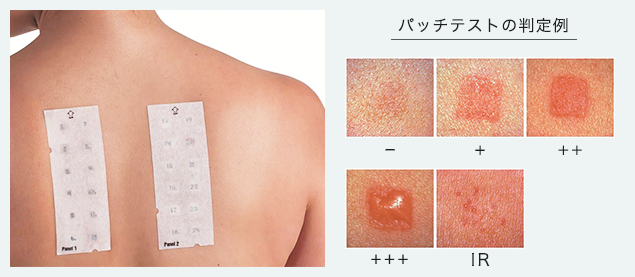
There are two main methods for testing the reaction of metal allergies: the contact test (48-hour closed patch test) and the blood test (lymphocyte stimulation test).
At the moment, the most common is the contact test, also known as the patch test.
There is also an advantage that the cost can be reduced compared to a blood test in that you only need to paste the reagent and follow up. Since insurance medical treatment is applied, you can receive it for about 1,080 yen with a 30% burden. Recently, the number of dermatology hospitals that carry out patch tests has increased. There is also a list of dermatologists who will perform patch tests at the end of this article.
However, the problem with the patch test is that, as a side effect, people with strong allergic reactions may leave marks, and during the test period of 48 hours to a maximum of 1 week, they do not take a bath and feel uncomfortable in the summer. That is also a disadvantage. It can be annoying to have to go to the hospital several times, and for those who are sensitive, some people feel a chilling disgust just by imagining the fact that the nickel or chromium solution is applied directly to the skin and left as it is for several days. I think there is.
On the other hand, the blood test has the advantages of no side effects (no traces left) and no discomfort like a patch test because the collected blood is tested, but the test cost is high. It is also said that the problem with blood tests is that almost all metals have some kind of reaction.
That is why human blood reacts sensitively to most metals. Not to mention metal allergies, most metals basically act as poisons to the human body. (= Metal poisoning)
Inspection items for metal allergy patch tests
The inspection items of the 48-hour closed patch test are
Aluminum (aluminum chloride)
Cobalt (cobalt chloride)
Tin (second tin chloride)
Iron (ferric chloride)
Platinum (platinum chloride acid)
Palladium (palladium chloride)
Manganese (manganese chloride)
Indium (indium trioxide)
Iridium (iridium tetrachloride)
Silver (silver bromide)
Hexavalent chromium (potassium dichromate)
Trivalent chromium (chromium sulfate)
Nickel (nickel sulfate)
Zinc (zinc chloride)
Gold (gold chloride acid)
Copper (copper sulfate)
Mercury (mercury chloride)
There are 17 types (16 types of metals, 17 types of metal ions).
I think these 17 types are selected because this is a metal that you may come into contact with on a daily basis.
However, looking at this inspection item, tantalum, hafnium, zirconium, and even relatively major titanium, which we use as rings, are not included in the item. Also, it does not contain ruthenium, which is used as a material for wedding rings, let alone rhenium or niobium. I think it’s too minor.
When it comes to patch testing for such metal allergies, I always say, “I don’t need it.”
That may sound a bit rough, but the patch test is a test that is positioned to test metals that may respond to some people and not to others. is.
Both gold and platinum are tested because some people may have metal allergies.
On the other hand, tantalum and hafnium are completely free from metal allergies. This is because there is no element that causes metal allergy because metal ions do not dissolve. No inspection is required, and it does not exist in the inspection items in the first place.
The constitution of metal allergies may change in the future
Some of the people who come to me for consultation
“Because my constitution changed after giving birth, I started to have metal allergies.”
“The platinum ring I wore at the beginning of my marriage has been itchy for several years and I can’t wear it, especially in the summer.”
There are people who say that. The constitution changes.
In that sense, even if you test for metal allergies and identify the metals that respond to you and the metals that do not respond, that is the result of the test and will be the same for the future. It’s not limited.
That’s why the metal allergy patch test results are unreliable as a criterion for choosing a material for a wedding ring that you can wear for the rest of your life.
Of course, I think it’s interesting to know which metal you have a metal allergy to as a way to understand the current situation.
・ Discomfort of metal allergy patch test, annoyance of multiple visits, possibility of side effects (marks remain)
・ In the future, the constitution may change and the test results may differ.
Given that, I am skeptical about the need for patch testing.
Disadvantages and advantages of metal allergy patch test Summary Advantages
merit
・ You can easily find out which metal has an allergic reaction.
・ Because insurance medical treatment is applied, you can receive it for about 1,080 yen with a 30% burden.
In addition, if you take a metal allergy patch test at a medical institution, you will be issued a medical certificate, so it seems that there is an advantage that hybrid ceramic can be used with insurance coverage in dental treatment.
Demerit
・ Several visits to the medical institution are required (first day, third day, seventh day, etc.).
・ During the inspection period from 48 hours to a maximum of 1 week, it is necessary to spend only in the shower without taking a bath.
・ Itching and red marks may remain for a while after the inspection period ends.
・ Metals that cause allergic reactions in many people, such as nickel and cobalt, must be inspected. Very painful for sensitive people.
・ The results of allergic reactions may change due to future changes in constitution.
A metal material that is safe even if you do not have to test for metal allergies
Considering the inconvenience of testing for metal allergies, there are materials such as tantalum, hafnium, and zirconium that you do not have to worry about metal allergies at all, so if you can choose them and feel at ease for the rest of your life, I think it would be better. I’m thinking, how about it?
I think it’s different from a general jewelry shop, but I want to save time and effort for those who come to me and those who find me. , I’m writing this column.
Jewelery shops around the world say, “People with metal allergies are advised to take a metal allergy patch test in advance” because their products are not responsible for metal allergies.
On the other hand, as a store specializing in metal allergies, we are responsible for carefully selecting materials and ensuring peace of mind.
I am confident in the sense of security of tantalum and hafnium, and I think the voices of these customers support our achievements.
Voice of a customer who ordered a ring from us
→ https://tokyo-diamond.jp/voice-tantalum/
Also, this “wedding ring that does not cause metal allergies” was developed for her (now her wife) who was suffering from metal allergies.
I’m writing the story at that time here, so I’d be happy if I could convey my seriousness ^^
→ https://tokyo-diamond.jp/hypo-allergenic-wedding-ring/
References / References:
Actual skin test
https://www.jstage.jst.go.jp/article/arerugi/57/5/57_KJ00004933910/_pdf
Patch test practice
https://www.jstage.jst.go.jp/article/arerugi/57/12/57_KJ00005180552/_pdf
Actual practice of prick test and patch test
https://www.jstage.jst.go.jp/article/arerugi/57/2/57_KJ00004879820/_pdf
Clinical relevance to patch test positive rate for metal allergies
https://www.jstage.jst.go.jp/article/skinresearch1959/42/1/42_1_11/_article/-char/ja/